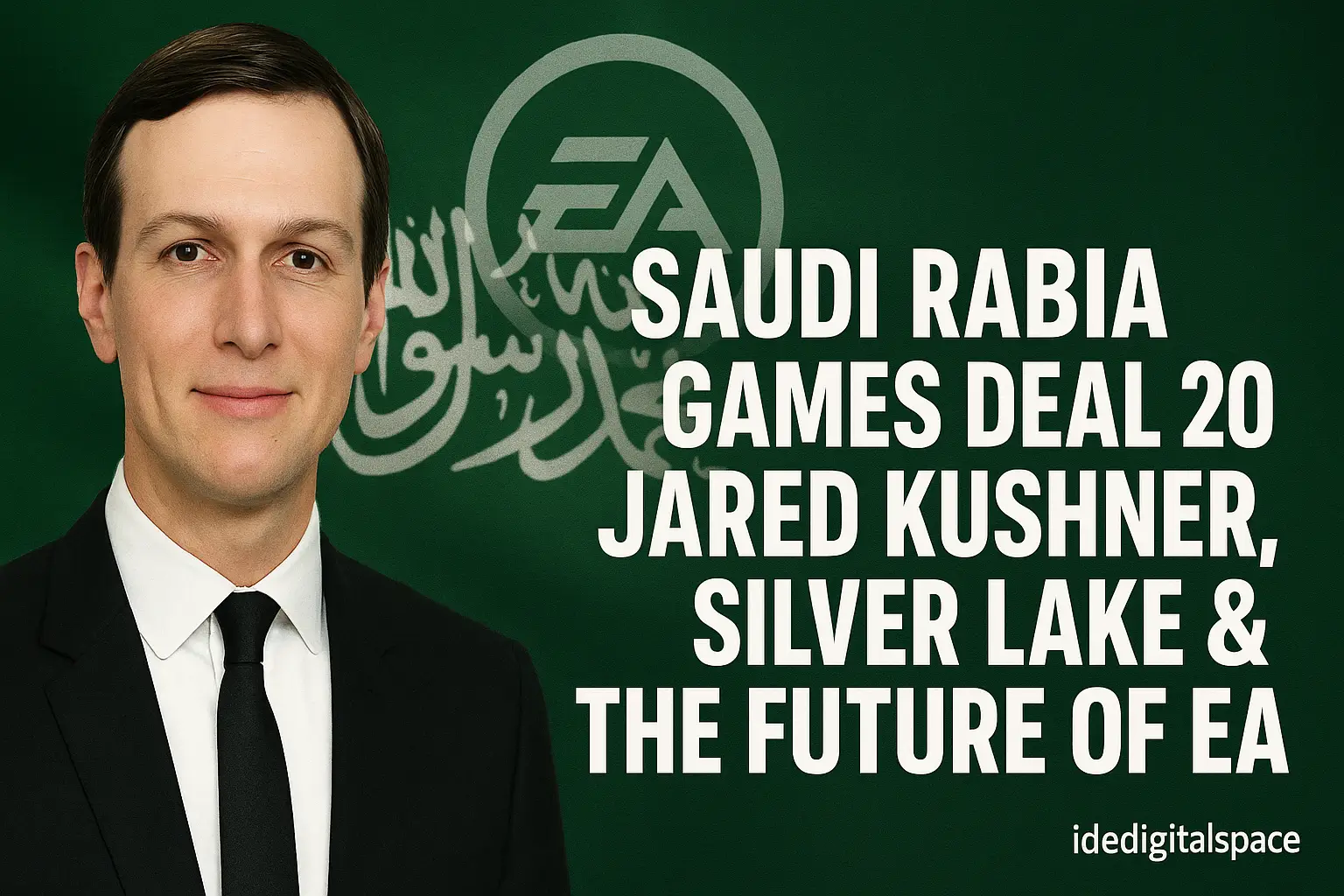
Introduction: A Game-Changing Acquisition in 2025
In late September 2025, the gaming and investment world was rocked by the announcement of the Saudi Arabia EA Games Deal—a $55 billion acquisition that will take Electronic Arts (EA) private. This bold move unites deep-pocketed investors—Saudi Arabia’s Public Investment Fund (PIF), Silver Lake, and Jared Kushner’s Affinity Partners—in what is reportedly the largest all-cash leveraged buyout in history. (ir.ea.com)
This transaction isn’t just about money. It signals shifting paradigms in gaming, geopolitics, and corporate governance. In this post, we unpack exactly what the Saudi Arabia EA Games Deal means for EA’s future, for its stockholders, and for the broader gaming industry.
Why EA and Why Now?
EA’s Position Before the Deal
Electronic Arts has long been a giant in digital entertainment, with flagship franchises such as Madden NFL, The Sims, Battlefield, Apex Legends, and EA Sports FC. But in recent years, the company has faced challenges: stagnating revenues, rising development costs, and market competition from mobile-first and free-to-play rivals. (Wikipedia)
As a public company, EA has been under constant pressure to show quarter-to-quarter profitability. That environment can stifle risk-taking, long-term investments, or pivots into new business models.
The Players Assembling the Deal
The Saudi Arabia EA Games Deal involves three core parties:
- PIF (Public Investment Fund, Saudi Arabia): Already a nearly 9.9% stakeholder in EA, PIF is rolling over its existing stake as part of the acquisition. (ir.ea.com)
- Silver Lake: A major technology-focused private equity firm with experience investing in gaming, tech, and entertainment. (ir.ea.com)
- Affinity Partners (Jared Kushner’s firm): Founded in 2021 by Jared Kushner, this investment vehicle has strong ties to Saudi capital and is participating in this transaction. (Wikipedia)
By bringing together Saudi state capital, private equity, and Kushner’s influence, this deal is as much political and strategic as it is financial.
Deal Mechanics & Financials
Structure & Valuation
Under the deal terms, EA stockholders will receive $210 per share in cash, representing a ~25% premium over the unaffected trading price before speculation emerged. (ir.ea.com)
The total enterprise value of the acquisition is about $55 billion, which includes approximately $36 billion in equity from the investor consortium and $20 billion in debt financing via JPMorgan. (ir.ea.com)
It’s notable that this is being touted as the largest all-cash sponsor take-private transaction ever. (ir.ea.com)
Timing & Conditions
The deal has already been approved by EA’s board, but it still must get regulatory and shareholder approval before closing. (ir.ea.com)
The expected close timeline is Q1 of fiscal 2027 (which is roughly within the first quarter of EA’s FY2027). (The Verge)
Once closed, EA’s shares will be delisted from public exchanges, and the company will operate privately under the new ownership group. (ir.ea.com)
Strategic Motives & Risks
Why Saudi Arabia and PIF Want EA
For Saudi Arabia, the Saudi Arabia EA Games Deal is part of a broader strategy to diversify its economy beyond oil and into tech, media, esports, and entertainment. PIF has already made substantial gaming investments globally. (AP News)
Owning a globally recognized gaming house like EA gives the Kingdom influence in shaping digital culture and entertainment trends. The potential to blend gaming, sports, and media fits well into Saudi Arabia’s broader Vision 2030 objectives.
For Silver Lake & Affinity Partners
Silver Lake sees longstanding tech upside in EA’s IP portfolio, live-service games, and recurring revenue models. Freed from public market pressure, the firm may help EA take bigger bets. (ir.ea.com)
Affinity Partners, under Jared Kushner, may gain leverage and prestige from managing a marquee acquisition with international influence. However, the firm is heavily tied to Saudi capital, meaning there may be political scrutiny. (Wikipedia)
Key Risks & Tensions
- Debt burden & cost-cutting pressure: With $20 billion in debt, EA will face pressure to generate cash and possibly trim operations or personnel.
- Regulatory and geopolitical scrutiny: Given Saudi involvement and Kushner’s connections, U.S. oversight agencies may intensely examine the deal.
- Creative autonomy vs control: As a private entity, EA’s new owners may push for safer, more monetizable content over creative risk.
- Public sentiment & backlash: Fans, critics, and industry watchers may balk at foreign control of an iconic U.S. gaming giant.
What It Means for EA’s Road Ahead
Operational Priorities & Leadership
EA will remain headquartered in Redwood City, California, and Andrew Wilson will continue to serve as CEO. (ir.ea.com)
With private backing, EA may pivot more aggressively into new gaming models: cloud gaming, generative AI content, cross-platform services, esports, and immersive experiences.
Shifts in Game Strategy
Under tightened financial discipline, niche or experimental projects may be deprioritized relative to bread-and-butter franchises like Madden, Battlefield, or EA Sports FC.
We may see:
- More live content, microtransactions, and subscription models
- Increased use of AI in content generation or game design
- Strategic studio consolidations or closures to reduce redundancy
- Focus on markets aligned with Saudi or Middle Eastern expansion
Impact on Fans, Developers & Industry
For fans, the Saudi Arabia EA Games Deal could bring mixed feelings: more investment and stability, but potentially less creative unpredictability.
For EA’s internal studios and developers, there is uncertainty around job security, creative flexibility, and budget allocations.
For the broader gaming industry, this is a signal that sovereign capital is fully entering the entertainment sector—and that control over IPs may shift to global power plays.
What About EA Stock & Shareholders?
The Shareholder Payout
Current EA shareholders will receive $210 per share in cash. That’s a 25% premium over EA’s “unaffected price” before takeover speculation broke. (ir.ea.com)
For many investors, that represents a guaranteed exit at a respectable valuation. But critics argue it might undercut EA’s future upside if the company thrives under private control.
Delisting & Implications
Once the deal closes, EA stock will be delisted from public markets. Retail investors and index funds will no longer hold EA shares. (ir.ea.com)
Analysts will re-evaluate EA’s value via alternative metrics such as cash flow, debt servicing ability, and growth trajectory.
Broader Implications & Final Thoughts
Gaming Meets Geopolitics
The Saudi Arabia EA Games Deal underscores how entertainment, technology, and geopolitics are increasingly intertwined. For Saudi Arabia, it’s a show of soft power. For EA’s legacy as a U.S. company, it’s a moment of transformation.
What to Watch
- Regulatory approval processes (especially U.S. scrutiny of foreign investment)
- How EA’s content roadmap evolves post-acquisition
- Any signs of interference or editorial control from new owners
- Layoffs or restructuring announcements
- Expansion into new markets or partnerships, especially in the Middle East
Final Take
The Saudi Arabia EA Games Deal is not just about money—it’s about influence, strategy, and the future shape of gaming. If this acquisition closes as planned in Q1 FY2027, EA will enter a new era: privately owned, with more flexibility, greater pressure, and perhaps more ambition. Whether it thrives or stumbles under new leadership remains to be seen—but the stakes are higher than ever.

नमस्ते दोस्तों! मेरा नाम मनोज मीना है और मैं एक ट्रैवल ब्लॉगर हूं। मुझे नई-नई जगहों की खोज करना, उनके बारे में जानकारी जुटाना और उसे आप तक पहुंचाना पसंद है। इस ब्लॉग पर आपको भारत और विदेश की बेहतरीन जगहों, टूर पैकेज, tour टिप्स और गाइड्स की जानकारी मिलेगी, जिससे आपकी अगली trip आसान और यादगार बन सके। आप मुझे इंस्टाग्राम और फेसबुक पर भी फॉलो कर सकते हैं।